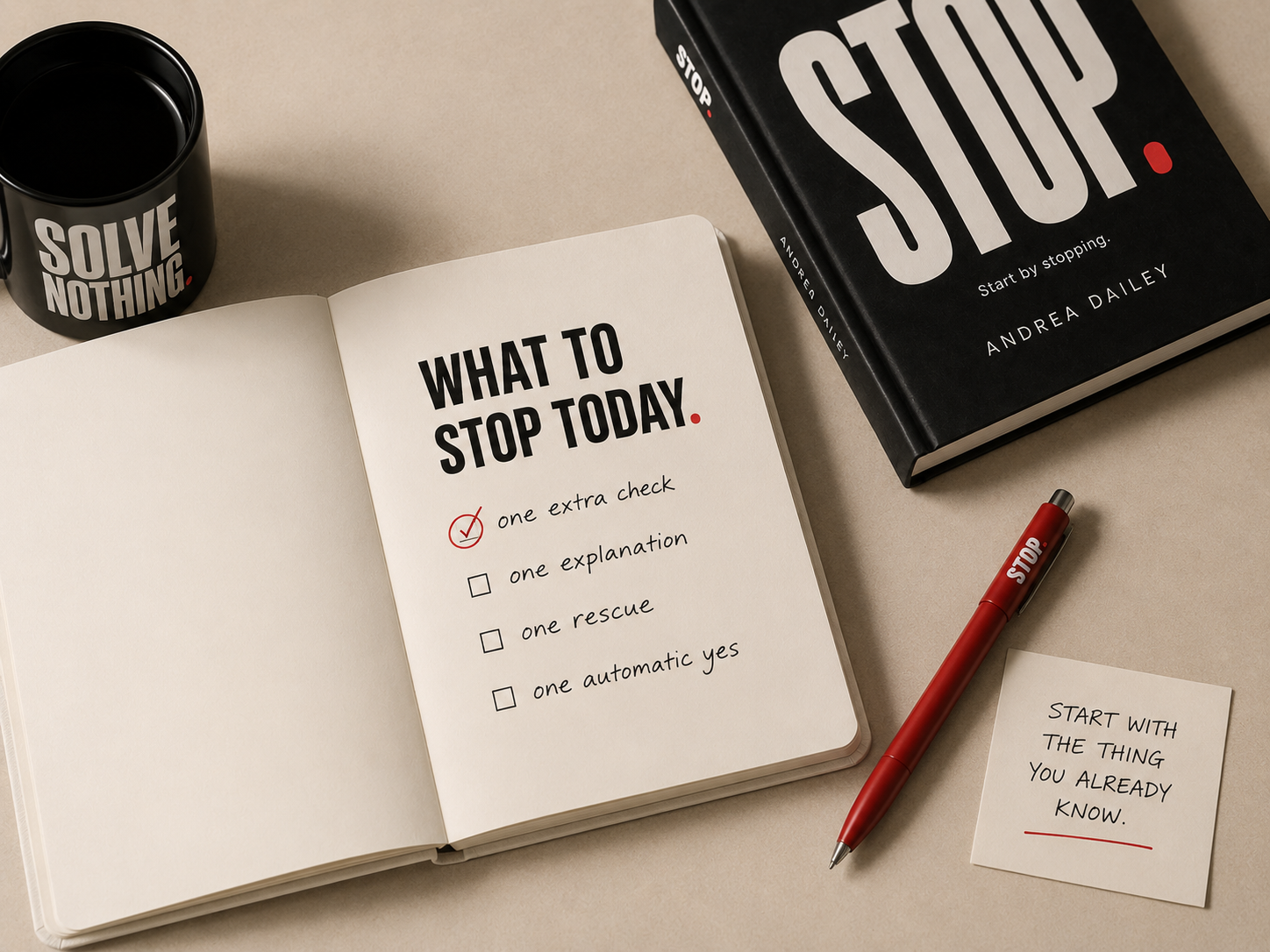
Start with the thing you already know.
You do not need to search your whole life for what to stop. You probably already know. It is the thing that keeps taking your time after you said you were done. The thing that keeps draining your energy before the day has even started. The thing you keep picking up because someone has to. The thing you keep explaining, checking, smoothing, fixing, answering, managing, carrying, or rescuing.
That is the place to begin.
Not the biggest problem. Not the oldest pattern. Not the thing that would require a full life plan, a hard conversation, and three weeks of emotional preparation.
Start with the thing you already know. The thing you keep doing automatically. The thing that costs more than it gives back. The thing your body already recognizes before your mind admits it.
That is your stop.
What makes something a stop
A stop is not always a huge decision. Sometimes a stop is small.
It is not sending the extra text. Not checking the thing again. Not saying yes before you pause. Not explaining after enough has already been said. Not taking over because no one else is moving fast enough.
A stop can be one sentence, one pause, or doing nothing for five minutes.
That may not sound like much, but habits do not usually change because you make one giant announcement. They change because you interrupt the automatic move. You stop the old pattern while it is still small enough to stop.
That is the practice.
What to stop today
Pick one thing today.
Do not pick ten. Do not turn this into a full reset. Do not make a list so long that the list becomes another thing to carry.
Pick one stop.
Stop one thing today:
- One yes you usually give too fast.
- One explanation you usually add because silence feels uncomfortable.
- One problem you usually take over because you know how to solve it.
- One message you usually send to manage someone else's mood.
- One check you usually do because waiting feels hard.
- One apology you usually give when you did nothing wrong.
- One rescue you usually call helping.
- One plan you usually make for someone who has not made one for themselves.
- One invisible job you keep doing because no one else notices it.
- One worry loop you keep feeding like it is useful.
One stop is enough to begin.
How to choose
If you are not sure what to stop, do not overthink it. Look for the thing with a cost.
Look for the thing that makes your body tighten. The thing you resent but keep doing. The thing you say yes to and immediately feel heavy. The thing you keep telling yourself is small, even though it keeps taking from you.
Before you choose, ask:
- What am I tired of carrying?
- What do I keep doing automatically?
- What do I already resent?
- What am I calling helpful that is actually costing me peace?
- What would give me back even a little time, energy, or honesty today?
Do not choose the most impressive answer. Choose the cleanest one. Choose the stop you can actually practice today.
How to do it
Once you choose the stop, keep it small.
Do not announce it to everyone. Do not turn it into a speech. Do not explain the whole pattern to the person who benefits from the pattern.
Just interrupt the old move.
If the old move is saying yes too fast, pause before answering. If the old move is explaining too much, use fewer words. If the old move is rescuing, wait. If the old move is checking, do not check for five minutes. If the old move is making the plan, let someone else make it. If the old move is carrying the mood in the room, let the room have its own mood.
You do not have to do this perfectly. You only have to catch one moment.
Then stop.
What counts as a win
A win is not changing your whole life today. A win is one honest interruption.
That can look like:
- I waited before saying yes.
- I used one sentence instead of five.
- I noticed the urge to fix it and paused.
- I did not send the extra message.
- I let someone else be responsible for their own problem.
- I felt uncomfortable and did not turn that discomfort into action.
- I caught the old move after I already did it.
That counts.
Even catching it late counts. At first, you may only notice the pattern after it already happened. That is still information. That is still awareness. That is still the beginning of the stop.
Next time, catch it sooner. Then sooner. Then before you move.
That is how the habit changes.
One stop at a time.
Start by stopping
You do not need another system for a life that is asking for less. You need one honest stop.
Start with the thing you already know. The thing that keeps draining your time, energy, or peace. The thing you keep picking up before you ask whether it belongs to you.
Stop that one first.
Not forever. Not perfectly. Just today.
One less yes. One less explanation. One less rescue. One less thing that was never yours to carry.
Start by stopping.