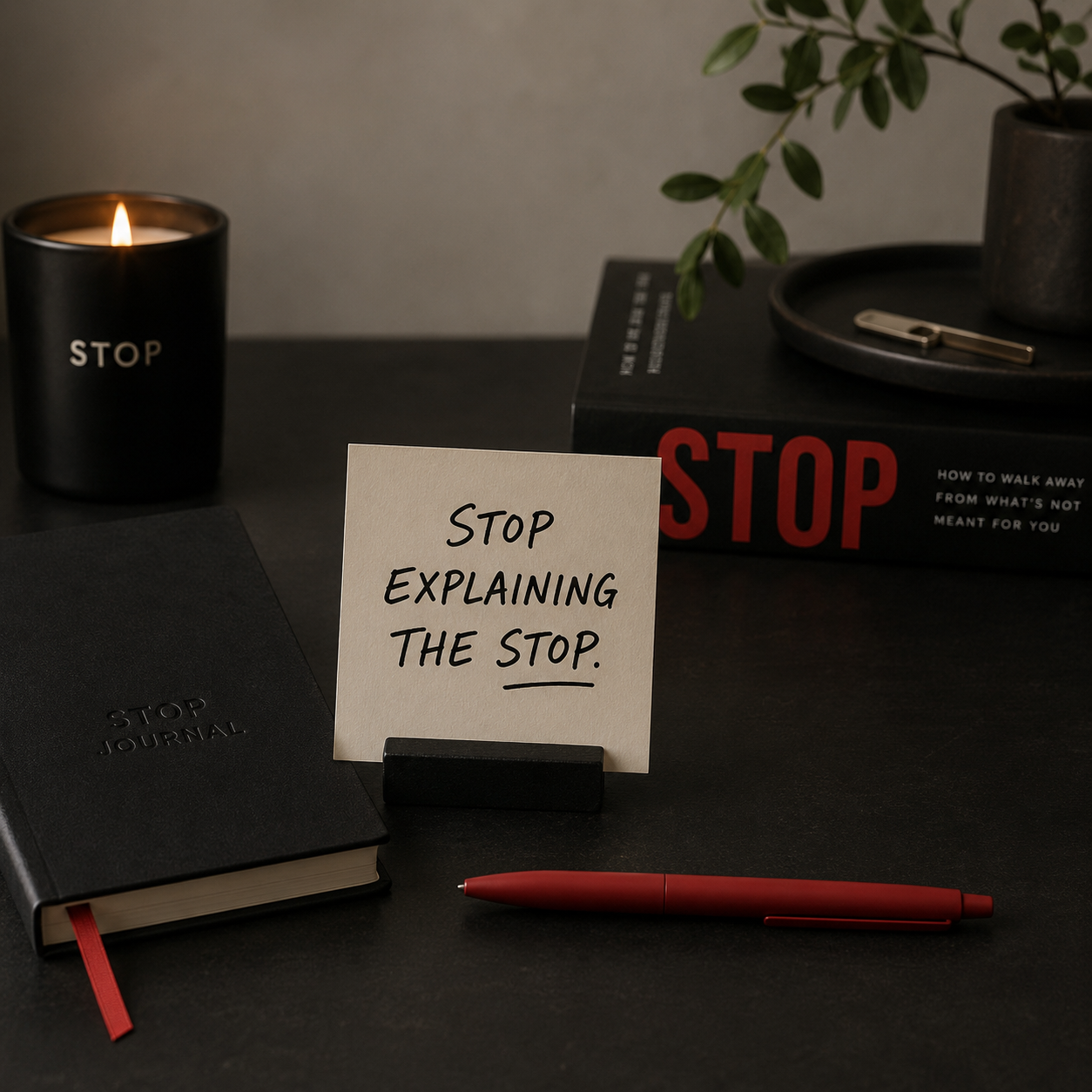
You do not have to make everyone comfortable with your boundary.
You can stop without turning it into a full explanation. You can say no without building a case. You can step back without writing a speech about why you are allowed to step back.
That sounds simple until you are the person who has been trained to make everything easier for everyone else.
So you say the boundary, then you explain it. Then you explain the explanation. Then you soften the tone. Then you add context no one asked for. Then you make sure the other person understands you are still kind, still good, still trying, still not the problem.
That is the habit.
Not the boundary.
The over-explaining after the boundary.
The stop is clean. The speech after the stop is where you start giving yourself away again.
Most people do not over-explain because they are unclear. They over-explain because they are uncomfortable being misunderstood. They want the other person to agree, approve, understand, forgive, or at least not be disappointed.
But a boundary does not become real only after someone likes it.
Sometimes enough has already been said.
The next move is not to explain more. The next move is to pause and ask whether more actually needs to be said.
The old explanation
The old explanation may feel responsible.
It may feel like kindness. It may feel like respect. It may feel like you are preventing conflict by giving the other person every possible reason, angle, detail, and emotional receipt.
Sometimes explanation is useful.
But sometimes the explanation is not communication. It is a rescue attempt.
You are trying to rescue them from disappointment. You are trying to rescue yourself from guilt. You are trying to rescue the room from discomfort. You are trying to make the stop feel acceptable before you let it stand.
That is exhausting.
And it usually does not make the boundary stronger.
It makes it easier to negotiate.
When you give every reason, people can argue with every reason. When you give every detail, people can question every detail. When you keep talking after the truth has already been said, the stop starts to look like an opening.
You are allowed to be done before the other person is satisfied.
The cleaner stop
A cleaner stop uses fewer words.
Not harsher words.
Not colder words.
Just fewer words.
"I can't do that."
"That does not work for me."
"I'm not available."
"I'm going to pass."
"I need to stop here."
Those sentences may feel too small if you are used to explaining everything. They may feel unfinished. Your body may want to add a paragraph. Your mind may start drafting the reasons.
That does not mean more needs to be said.
It may only mean the old habit wants to keep working.
The cleaner stop is not about being rude. It is about letting the true sentence stand without covering it in extra words until it disappears.
You can be clear without being cruel.
You can be brief without being careless.
You can stop without turning the stop into a full report.
What to stop today
Pick one place where you usually explain past the point of clarity.
Do not pick the hardest conversation in your life. Do not pick the person who always pushes back. Do not pick the situation that needs a full plan.
Pick one small moment.
Stop one explanation today:
- One extra reason you usually add after saying no.
- One paragraph you usually send to soften the answer.
- One apology you add when you did nothing wrong.
- One defense you give before anyone has challenged you.
- One sentence you repeat because silence feels uncomfortable.
- One attempt to make someone fully understand before you let yourself be done.
One stop is enough to begin.
Pause and ask
Before you explain, pause.
That pause matters.
It gives you one second between the old habit and the next sentence. One second before you soften the no. One second before you add the paragraph. One second before you try to make someone else comfortable with the boundary you already stated.
The pause is not empty.
The pause is where you ask:
- Have I already answered?
- Am I adding clarity, or am I trying to manage their reaction?
- Am I explaining because it is needed, or because I feel guilty?
- Would this be cleaner with fewer words?
- What happens if I stop talking now?
Then wait.
Do not fill the silence just because it feels uncomfortable. Do not send the second paragraph. Do not turn a clear no into a long emotional report.
You can be respectful without over-explaining. You can be kind without making your boundary smaller. You can care about someone and still let them have their own reaction.
That is the practice.
What counts as a win
A win is not feeling perfectly calm.
A win is stopping the explanation sooner than usual.
That can look like:
- I said no and did not add three reasons.
- I used one sentence instead of a paragraph.
- I paused before apologizing.
- I let the other person be disappointed.
- I did not try to make the stop feel perfect.
- I noticed the urge to explain after I had already explained.
That counts.
Even if you explain too much and catch it later, it counts. The first stop may happen after the old habit has already started. Fine. Next time, catch it sooner.
Then stop.
Start by stopping
You do not need to convince everyone that your stop is reasonable before you are allowed to keep it.
You do not need another paragraph.
You do not need a better defense.
You do not need to make the whole room comfortable.
Start with the sentence that is already true.
Say it cleanly.
Pause before adding more.
Then let it stand.
Start by stopping.